Showing posts with label Italy. Show all posts

Monday, July 2, 2012

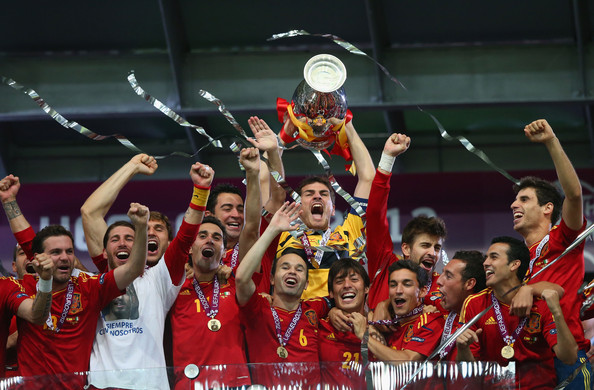
Euro 2012 final: Spain-Italy 4:0

SPAIN
4:0
ITALY
Silva 14', Alba 41'
Torres 84', Mata 89'


My match rating: -_-
My man of the match: Iniesta (S)

UEFA report ---|||--- Player ratings ---|||--- Photos ---|||--- Highlights


Well, fuck.

No, not really. Spain was the better team and they played like it. The score, unfortunately, is too severe to the losers and doesn't adequately represent the values on the pitch. If Italy had played their best and had not had to be down to ten men, Spain would have probably won it 2-0 or 3-1, and that would have been more representative. But c'est la vie. As I said many times before and I won't take back now, at the end of the day all that matters in football is the scoreline, and the rest is chatter.

Italy ought to find pride in the rest of their tournament. Somewhat like Lippi in 2006, Prandelli has designed an efficient football machine by bunching inexperienced youngsters around the three pillars Buffon, De Rossi, and Pirlo. And in the midst of a major legal scandal back at home, this ragtag team won a ticket to the final of football's most difficult international tournament, only to lose to the best team of... probably the last two or three decades; best of all time, according to some madmen, but we don't listen to madmen.

So, once more, Forza Azzurri!

Some more miscellaneous end-of-tourney reflections on Euro 2012 are forthcoming.
.
.

Saturday, June 30, 2012

Euro 2012 semifinal: Germany-Italy 1:2

GERMANY
1:2
ITALY
Ozil 90' (p)Balotelli 20', 36'

My match rating: ★★★
My man of the match: Balotelli (I)

UEFA report ---|||--- Player ratings ---|||--- Photos ---|||--- Highlights


Commentary to follow!!
.
.

Sunday, June 24, 2012

Euro 2012 quarterfinal #4: England-Italy

ENGLAND
2:4
ITALY
              0 : 0   a.e.t.


ORDER OF PENALTIES
Balotelli (0:1), Gerrard (1:1), Montolivo (1:1), Rooney (2:1), Pirlo (2:2),
Young (2:2), Marchisio (2:3), Cole (2:3), Diamanti (2:4)


My match rating: ★★★
My man of the match: Pirlo (I)

UEFA report ---|||--- Player ratings ---|||--- Photos ---|||--- Highlights


History repeating... in reverse. In the semifinal of Euro 2000, Italy and Holland were tied 0-0 after extra time. It had been a crazy match. Italy played with a man down for over an hour after Zambrotta's ejection. Yet the Dutch couldn't capitalize and missed two penalties in regulation. It went down to a shootout. Before a baffled home crowd in Amsterdam, Italy's Toldo saved three more and gave his team the final.

That match was significant for two reasons. For one, it was the first time that Italy won a penalty shootout, having lost that way three straight times in the last decade: to Argentina in the 1990 World Cup semi, to Brazil in the 1994 World Cup final, and to France in the 1998 World Cup quarters. The "damned penalties" were the bane of Italy's football throughout my childhood... but not this time: this major win on penalties felt like a long-time-coming liberation. The other reason was Francesco Totti. In the shootout against the Netherlands, Italy's star winger scored the most daring penalty I have ever seen anyone take (video here). In English they call it a "Panenka penalty," after the Czech player who pioneered it in 1976. In Italy we simply call it "the spoon," given its soft and curved trajectory. Totti's comment in tight Roman dialect during a TV interview ("gli ho fatto er cucchiaio!" = I gave them the spoon, an obvious double-entendre) quickly became a national catchphrase. Kicking a penalty that way is of course extremely risky, for all the goalie has to do to save it is stand still and welcome the ball as it flies gently into his gloves. The appeal, then, is that no goalie ever does that. He always commits to a side and dives, hoping that it's the side that the kicker has chosen, and by the time he's down he has no time to get back on his feet and catch the "Panenka." It is, of course, extremely irreverent; some who don't really get football even call it disrespectful or unsportsmanlike.

And today, in the penalty shootout against England, Pirlo "gave them the spoon" again. Only that this time Italy was down a penalty, while in the Netherlands match they were still even. It was incredible. To do something like that you must be either totally insane or totally confident. I think Totti was insane and Pirlo was confident. He looked calm and in control, just as he had in 2006 when he shot a great (conventional!) penalty against France in the World Cup final. His face betrayed no emotion. After the goal, he didn't even cheer, which is uncharacteristic for him. He knew exactly what he was doing. One may then ask: why did he do it? What need was there to take such a risk? As every leader should, Pirlo knew that after Montolivo's error Italy's chances were waning and his young teammates were losing hope. So since the next two penalty takers (Marchisio and Diamanti) were young and inexperienced, Pirlo must have felt that he needed to blow the horn. And what better way than to reference the classic cucchiaio, the moment that Italy broke free from the "damned penalties" and, at last, came out on top? I think Totti was just cocky in 2000, but I am positive that all of this was going through Pirlo's mind tonight as he walked up to the spot. He meant to do it, he meant to send a message, and he knows very well that certain actions in football speak much more loudly than their intrinsic value. If I am right, then this was a sublime moment in football strategy and sports psychology. It must have peeved the Brits, too, as they would not score again thanks to the misses by Young and Cole. I am reluctant to congratulate Buffon for the save on Cole, for whenever a penalty doesn't go in, it's the kicker who did something wrong. The goal is very, very large, and the spot is very, very close. If the kick is good, the penalty is virtually unsavable. With that said, good job Gigi for guessing right three times out of four and eventually grabbing this one!

There is not very much to say about the rest of the match. Italy dominated far and wide, as you can read in the reports linked. They attacked relentlessly but with order for 120 minutes, shooting a 35 times, of which 24 on goal, and leading twice as many overall attacks as England. De Rossi effectively shut out Rooney for the majority of the game, keeping England's star to one shot, one header, and very few touches overall. As usual, De Rossi and Pirlo engineered the Italians' midfield dominance. For lengthy stretches, including the last 20 minutes of the first half and the first 20 of the second, England did not shoot on goal. For much of the second half they never even crossed their own midfield. It was as one-sided a match as I have ever seen in a major international tournament. As the Britons are older and more experienced than Italy's makeshift team, credit goes to Prandelli for out-smarting Hodgson at what was essentially a game of chess. Football matches are played on the pitch, but they are won on the tactical board, and tonight was resounding evidence of that fact.

With all that said, it is an utter embarrassment that Italy had to win on a penalty shootout! The match "should" have ended 3-0, for that was the tactical, technical, and competitive disparity reflected in the actual play. But surely all the world's best tactics are useless if you don't actually put the bloody ball past the bloody line, and that Italy failed miserably to do. Balotelli had his usual great chances, which again he wasted, and it was again pretty ugly. De Rossi and Pirlo hit two posts. Montolivo failed to tap in the proverbial "I-would-have-scored-that-too!" ball after a half-assed save from Hart. England had their fair share of opportunities, too, but it makes sense to shoot on goal only 8 times and remain scoreless. But 24 times? And like this? Despite the tactical superiority and despite the resilience that eventually got them through, Italy are still lacking in the area that counts the most: scoring. That won't fly against the Germans, who will have as many chances, and they will convert them. Gomez doesn't wait too long to shoot. Lahm doesn't hit the post. Podolski doesn't fail the tap-in. Between now and Thursday, Italy will have work to do.

Speaking of Thursday, as the ESPN commentators Darke and McManaman rightfully remarked, the Euro 2012 calendar is unfairly laid out. When Italy and Germany play the second semifinal, Italy will have had only three full days' worth of rest. That wouldn't be a problem if it weren't that Germany will have had five. In major international events, with so many games crammed in a single month, every day counts. The winner of Italy-England would have been at some disadvantage because of the extra time and penalty shootout, but there's no way to control that: it's just part of the game. But there was a way to account for the different resting periods, and that is UEFA's fault. Traditionally, quarterfinals are played two-a-day, not one, precisely to avoid this kind of problem. I understand that it pays better and is more spectacular to have them spread out over four days, but they could have simply allowed everyone an extra day's rest between group stage and quarters, so as to allow the teams on the same side of the board to play on consecutive days. That would have reduced the first team's "advantage" to only one rest day, which is not crazy. Or they could have allowed that extra rest day between the quarters and the semis, because the difference of two full days' worth of rest is less relevant when the more tired team still had four full days to recover (that is, 4 and 6 is less unfair than 3 and 5). Either way, it should have been managed better. I'll just go ahead and blame monsieur Platini, for this and for all that is wrong with European football. It's easier!

The Italy-Germany rivalry is thus renewed. Another semifinal, like in 1970 and 2006, except this time it's the Euro and not the World Cup. Throw in the 1982 final and you have an absolutely stellar, unique set of precedents that no other two major teams have. The two teams have never met at a Euro, and Germany has never beaten Italy in a major tournament (see here). In 2006 especially, Italy had started off as the outsider. They were told they didn't stand a chance and that the Germans would cruise on their dead bodies on their way to the final. Well, we know how that turned out. This year, Italy's chances are still low, but they're not afraid of Löw, and they're flying to Warsaw in four days to prove it.
.
.

Friday, June 22, 2012

World War to World Cup: the great football rivalries of Germany, England, and Italy

The winner of Sunday's Euro 2012 quarterfinal between England and Italy will advance to play Germany in the semifinals. Whoever it be, a match-up of historic proportion awaits. Germans and Britons share a historic rivalry, as do Germans and Italians; and if the former is far more storied from a footballing viewpoint, the latter is more socially significant. Either way, fun will be had. Football is a mirror of life, and life is much more than the aggregate score of our wins and losses. Life is a story, and few national teams in the world have more history than these three.


Germany-England may be the single most hyped international match-up in football, perhaps second only to Argentina-Brazil, and right up there with Italy-France. It inevitably reeks of Dunkerque and Berlin, but it would hold up even just competitively, as the two have dominated the European sports scene for the longest time.

At the 1966 World Cup, hosted on British soil, the two disputed a classic final. England led for most of the match, but Germany equalized with a minute left in regulation to force extra time. In extra time, Geoff Hurst scored an incredibly controversial goal. His shot bounced off the crossbar and on the goal line, and the linesman ruled it in after brief consultation with the referee. Video footage then subsequently proved beyond any doubt that the ball had not in fact crossed the line. Here you can watch this video of the goal (about one minute in) or even the full match. This is bad enough when it happens in any game, but in a World Cup final it's bound to leave scars. The ensuing rivalry has been largely defined by this incident.

Four years later, at the 1970 World Cup, the Germans struck back by knocking the Brits out 3-2 in the quarterfinals. This time, Hurst saw a legal goal mysteriously disallowed. Needless to say, conspiracy theories abound: "Revenge, revenge!" Nevertheless, this match did not turn out to be very notorious after all, perhaps because it happened relatively early in the tournament.

Fast-forward 20 years to the 1990 World Cup. England and Germany this time met in the semis. Bobby Robson's England had just survived a thrilling quarter against the surprising Cameroon, while Franz Beckenbauer's Germany had never looked more stylish and confident. Despite some excellent individual talent (Platt, Lineker, Gaiscogne, Shilton), this was a year of reconstruction for England. Instead, Germany could count on some of their best-ever players: Matthaus, Klinsmann, Voeller, Brehme, Kohler... an absolute wunder. Germany again defeated England, but this time it took a penalty shoot-out and two mistakes from the spot. Beckenbauer's team then went on to win the cup in a nerve-filled match against Maradona and his Argentine thugs (who had just knocked out the hosts Italy and thus had the entire stadium against them!).

The 1990 match is mostly remembered for British winger's Paul Gaiscogne's unstable behavior. "Gazza," as he was nicknamed, was notoriously hotheaded, at times harmlessly irreverent, at others violent and downright stupid. Gazza was booked early in the second half, and since he had also been carded in the Cameroon game, he would have had to sit out the final had England gone through. His tears upon seeing the yellow card are among the most iconic images of the whole tournament and have been broadcast more times than I can count. However, I prefer the picture that came right after and which is less often discussed: England's captain Gary Lineker, upon seeing his teammate become emotional and recognizing the early signs of instability gestured to his bench that they should keep an eye on him. Here you can see a brief video of those crucial moments. I caught Lineker's warning live when I watched the game (I was nine years old) and I still remember it clear as day!

The rivalry remained relatively dormant for twenty more years (but see below), until the 2010 World Cup. Germany were the star of the tournament after sweeping the group stage in grand fashion, while England was once again facing a generational shift and looked quite insecure. Surely it didn't help that Beckham was on the bench as a manager, wearing an ugly suit. Be that as it may, the two met in the quarterfinals, and it was the perfect next chapter to the never-ending saga. The score was 4-1, but this time for the Germans, and this time it was England who could recriminate. Toward the end of the first half, with the score still at 2-1 for Germany, a shot by English midfielder Frank Lampard bounced off the crossbar and on the goal line. Sound familiar? It was obviously in... like, by a full 5-6 inches... but the linesman ruled it out and disallowed what should have been the equalizer. You couldn't write a better script; or a worse one, depending. If revenge is a dish best served cold, how about 44 years later? To be fair, Germany would have probably still prevailed, and to be even fairer they had taken their fair share of revenge ever since that day at Wembley... but to me, this one takes the cake. It is just too perfect.

You can read more about this rivalry at this Wikipedia article, which is surprisingly well-balanced and very informative. It discusses more games than I cover here and in more detail.


Italy-Germany is certainly much less of a rivalry, internationally anyway. For one, they have played relatively rarely: only three major matches in the last 40 years. Also, it's not a real rivalry if one side dominates: Italy has won all three.

But those three were very important, and especially the first one: Italy-West Germany 4-3, which was the 1970 World Cup semifinal, is often referred to as "the Game of the Century." In Italy it is even known as "the best football match in history." While no one match should ever be called that, if one ever deserved it, it's this one.

In 1970, Italy has one of its youngest-ever teams and is trying to get back onto the international scene after a streak of disappointing World Cup performances. It is especially important that the Italians wash away the humiliation of Chile 1962, where the Azzurri were knocked out by the home side in one of the most violent football games in history (the "Battle of Santiago"). On the other side of the pitch, the Germans hunger for revenge after 1966, a loss that is burning now more fiercely than ever. Also at stake is a chance to defeat the divine Brazil of the divine Pele in another epic Europe-South America showdown. To put it mildly, the match is charged.

That kind of match is usually boring, but not this time. Just look at the lineups! Rivera, Mazzola, Riva, and Boninsegna for the Italians... Beckenbauer, Vogt, Muller, and Seeler for the Germans. Italy goes ahead and dominates far and wide, but Germany shows an impressive resilience and equalizes with minutes left in regulation. The extra time would be remembered for its five goals in just under 20 minutes. Muller scores almost immediately for Germany. Burgnich equalizes for Italy not five minutes later, and soon thereafter Riva sets the score 3-2. It seems over: all players are exhausted, and the psychological impact of Italy's sudden comeback should prove too much for the Germans. However, Muller puts one in for the 3-3. This is now devastating for Italy and they should be demoralized... except not, for it takes Rivera all of 45 seconds to score again for the definitive 4-3! As soon as Rivera's ball crosses the line, two German defenders collapse on the pitch in an obvious sign of defeat. Despite a few more attempts, Germany would not score again. Italy would then lose a one-sided final to Brazil, in which they scored first but were overtaken 4-1 by Pele & Co. But as you can read below, that was almost irrelevant in the big picture.

You have to understand the social influence of this match in the lives of average Italians. Ever since the end of World War II, the word "German" had been synonymous with "murderer" and "monster." Even the adjective tedesco is sometimes used to mean "unusually cruel." Now, Italy is a non-nation of heterogeneous people held together by an empty state formality and little common history; Italian sociology is thus notoriously difficult to interpret. But given the alternate fates of Italy in the war, such a deep-rooted hatred for Germany is not surprising and it brings together Italians of different stripes where common ground would otherwise not exist. Germany was never really an ally, during the war. It was always perceived as an invader, as Hitler held the reins of his puppet Benito. Post-1943, then, the SS took out their resentment on Italian civilians in a series of barbaric massacres that killed thousands. Now Italy-Germany is a complex relationship (as is every relationship in Europe), with light hints of penis envy and dark tints of Stockholm syndrome. And all this cultural baggage was poured out into the match, which was suddenly elected, in the minds of many Italians, as the first true shot at vendetta. My father, who was 25 at the time, recounts of bars and taverns filled to the brim with people hoping to catch a glimpse of the only television available in the neighborhood; of scenes of jubilee in the streets, as if Italy had already won the world cup; and of how Riva and Rivera's names were exalted like those of saints, eliciting cries of blasphemy from our Vatican neighbors (themselves foreign invaders, of course, but that's another ballpark).

In current-day Italian, "Italy-Germany 4-3" is a common idiom. It signifies a pivotal struggle that, no doubt, you're going to win in the end if you just hang in there. The sports section of any major bookstore always carries a few books related to the event. A major motion picture, Italia-Germania 4-3, was a huge box-office success. I have seen at least three different feature-length documentaries on the history of the match, featuring interviews with all the major Italian and German players. It is, in short, an iconic cultural symbol whose importance has not yet waned.

You can watch the full match here, with Italian commentary, or a set of highlights here, in English.

That is not to say, of course, that the history of Italy-Germany ends there. In fact, the two major matches that followed were even more crucial, competitively speaking. At the 1982 World Cup, Italy and Germany played in the final, which Italy won 3-1 in a dominating performance. No doubt the Germans were exhausted after a prolonged semifinal against France, just as the Italians had been in 1970 against Brazil! Still, the goals by Altobelli, Rossi, and Tardelli would prove to stick with the Italian public, especially Tardelli's celebration, which is still dubbed "The Scream" (see the video here). From a strictly footballing viewpoint, this win is as clearly remembered as the one in 1970, for this was Italy's first World Cup since the 1934-1938 double. This meant, of course, that there was a whole generation of Italians who had never witnessed such an event, and it stuck in their memory. Alas, I was only one year old and remember none of it! Shucks...

Finally, at the 2006 World Cup, Italy and Germany again squared off in the semifinal. Germany hosted this edition of the WC, and they had looked dominant as ever. Italy, instead, had been cunning and resourceful, but hadn't displayed great prowess. The match was a tight 0-0 until the end of extra time, when Italy scored an impressive double whammy in the 117th and 119th minutes. Grosso's bender was especially momentous, and his celebration brought back memories of Tardelli in 1982. Here's a video of the last two minutes of that match with a colorful Italian commentary. For Germany it was a nightmare. For Italy it was the start of a dream, as they then went on to defeat France in the final in the latest chapter of that rivalry.

But, as they say, that's another story!


.

.

Monday, June 18, 2012

Euro 2012: group C third round possible outcomes

At the end of the three group matches, two or more teams may be tied; perhaps even all four. Rematches or penalty shootouts are impossible at this stage, so UEFA's tie-breaking regulations apply. Click on the link  to read them entirely, or you can read my quick summary instead.

Below are all nine possible scenarios in Group C. It's not going to be easy for Italy, so let's hope that Spain and Croatia are honest and don't fix an easy draw with lots of goals (but see some reflections on that here...)


Click to enlarge. Right-click and save to download.

.

Friday, June 15, 2012

Keeping up with the Marios: Italian scandals and history repeating

When group C plays its last Euro 2012 group-stage round on Monday, there is distinct possibility that Spain and Croatia fix their match and advance both, leaving Italy behind.

Even if Italy defeats Ireland, which is of course far from obvious, its fate still depends on the outcome of the Spain-Croatia match. If it has a winner, whoever wins it advances with 7 points, along with Italy who will then have 5. But if that match is a tie, then all three teams will end up with 5 points and we will need a tie-breaker to decide which two advance.

And therein lies the catch: if the Spain-Croatia draw ends 2-2, Italy is mathematically out, regardless of how well it defeats Ireland. This is because according to UEFA regulations, the relevant tiebreaker in this case is how many goals the three tied teams have scored only in the matches played among themselves. So it's both irrelevant how many goals Italy scores in defeating Ireland, for those goals won't count toward the tie-breaker; and relevant how many goals Spain and Croatia score in their draw, since all of those goals will count. I will post a much more detailed analysis tonight, discussing all groups and all tie-breaking rules.

The reason for the existence of this rule is to curtail the influence of "cushion teams." Sometimes there are much weaker teams that, on the last match day and upon seeing themselves already knocked out, may be bribed to (or decide to) concede many goals to their opponent, who may have an interest in improving its own goal difference to increase its chances of breaking a tie in its favor. So instead of breaking ties only by goal difference earned in all the disputed group matches, the rule now breaks ties according to "alternate" goal difference, that is, the goal difference only among the teams in question, those that are in fact tied. But surely even this rule leaves open the possibility of dishonesty, which is precisely the one in question. At most, it but reduces the likelihood of foul play.

What is more, this isn't the first time that this happens to Italy. Back at Euro 2008, Italy's group also included Sweden, Denmark, and Bulgaria. Italy was lagging, and on the third matchday, a 2-2 draw between Sweden and Denmark would knock Italy out mathematically. Surely enough, even though Italy beat Bulgaria, Sweden and Denmark slowly played their way into a 2-2 tie, including two (literally) incredible goals caused by defensive mistakes. UEFA probed for foul play, but nothing came out. Nor could it have, because when the outcome is so obvious, there is no need for an explicit agreement: all players, coaches, and staff "just know." Likewise, this Monday at Euro 2012, there will be no need to envision Iniesta and Modric meet at some shady cafe in a Polish small town and agree to fix the match over a Pabst and a good cigar.

Fixing things like that is the Italian way, after all! Sports journalist Caterina Camerlengo argues in this op-ed that it would be extremely hypocritical of Italians NOT to expect foul play from Spaniards and Croatians. For the past six years, Italian football has seen scandals so serious that they will eventually bring to the downfall and dissolution of calcio as it exists today. It's now clear that it's common practice for Italian football professionals to fix matches, bribe, bet, and trade gifts and sex for certain favors on matchday. This involves players, coaches, administrators, agents, and of course referees. Since 2006, over 100 people have been arrested and over a thousand questioned by police departments nationwide. Millions of euros' worth of fines have been levied, and some individuals have done considerable prison time. Yet, very little changes.

And we would dare be surprised if two other nations decided that they didn't want to bother being fair to us, after all?

Yes, Spain's and Croatia's footballing federations are currently above suspicion, which means that there is a relatively low likelihood of them even entertaining the idea of a stitch-up. And yes, Italy's scandals are for the most part domestic and have not yet marred international football, except of course to further diminish the already low weight that FIGC (the Italian football governing body) carries within UEFA.

Yet, I can't shake the thought that if Spain and Croatia fix or otherwise tacitly agree on a 2-2, or simply don't do much to change that score should it naturally arise, then in some way Italy will have deserved it. And if you know how much the Euro means to me, you know that I wouldn't say that lightly. Italy's 2006 world cup win ranks as the single happiest moment of my (sports-fan) life, especially as it came on the heels of a major international humiliation for the betting scandal. But this time, I think we've gone too far, and I wouldn't be so shocked if others decided to pay us back in the same currency.

Unless, of course, they decide to do the Jesus thing and turn the other cheek, but neither Spain nor Croatia are very religious countries -- again, that should be Italy's territory!
.
.

Thursday, June 14, 2012

Euro 2012: group C matchday 2 analysis

ITALY
1:1
CROATIA
Pirlo 36'Madzukic 71'

My match rating: ★★
My man of the match: Pirlo (I)

UEFA report ---|||--- Player ratings ---|||--- Photos ---|||--- Highlights


Another dominating first half by Italy that results in a much smaller lead than it should have. If we had converted all even a quarter of our chances, we would have gone to rest up 2-0. That one goal makes a huge difference, both psychologically and for actual scoring purposes. This is even more infuriating given the high quality of Pirlo's masterpiece performance. Not only does he still got it, but how. What a fantastic player.

Instead, Italy allowed Croatia to regain its strength, and regain it they did, as the rational and direct team that they are. Modric's midfield dominated large parts of the second half and the Italians kept falling further and further back. With that said, the equalizer only came due to a monumental marking error by Chiellini. As by now is  beginning to become usual, Prandelli's boys don't seem to be holding up for the whole 90, physically but most of all psychologically. Of course, this is an alarming sign. It speaks of a weak mind, and weak-minded teams always lose in the end.

Now it becomes very hard for Italy and easy for Croatia. As usual, in four-team groups you must win, and if you don't, it doesn't matter how well you play or how many goals you score when you draw. Let us hope that Spain and Croatia don't decide to "fix" their match, which would automatically knock Italy out even should they beat Ireland. More on all this tomorrow after the end of group D.


SPAIN
4:0
IRELAND
Torres 4', 70'
Silva 49'
Fabregas 83'


My match rating: ★★
My man of the match: Torres (S)

UEFA report ---|||--- Player ratings ---|||--- Photos ---|||--- Highlights


EL NINO! Torres is back, and oh my gods is he ever. Way to send a clear "fuck off" message to the critics. Or, to be a little more optimistic, way to say "thank you!" to Del Bosque. The coach's faith in Nando was rewarded immediately with a stellar goal in the opening five and another late in the second. Even more importantly, Torres displayed a lot of confidence and played like a classic main forward: a tall, strong post who can keep possession (giving the rest of the team ample time to arrive) or create mouth-watering opportunities for himself.

Torres isn't all that worked well, though. The whole team seemed to regain confidence and fall back on the team play that gave Spain a back-to-back Euro and World Cup in 2008 and 2010. As ESPN commentator Ian Darke so well put it at the end, Spain hadn't gone anywhere: they had simply met a like-minded and highly technical team, like Italy, who gave them a run for their money. As soon as they could play against a lesser opponent, they got back into it.

Indeed, Ireland was not a very worthy opponent at all. The Irish were frustrated by Torres's early goal in what was for them an elimination game. You simply don't play well when you're under from the get-go and you know you must win, or at least draw. But even considering that, there simply doesn't seem to be a lot of talent in this Irish team, which is now mathematically out of Euro 2012.

Much like for Croatia, instead, the odds for Spain are looking quite good, both to simply advance but also to win the group. Again, look for my "third-round special" post tomorrow evening!


GROUP D STANDINGS

teampointswinstieslossesgoals+goals-
SPAIN
4
1
1
0
5
1
CROATIA
4
1
1
0
4
2
ITALY
2
0
2
0
2
2
IRELAND
0
0
0
2
1
7


Sunday, June 10, 2012

Euro 2012: Group C matchday 1 analysis

SPAIN1:1
ITALY
Di Natale, 61'Fabregas, 64'

My match rating: ★★★
My man of the match: Pirlo (I)

UEFA report ---|||--- Player ratings ---|||--- Photos ---|||--- Highlights


What an excellent game! I was worried that it might be a one-sided affair, with Spain tiki-taka'ing their way to a 3-0.

Instead, Italy found their footing early and kept the Spaniards on their toes for the first hour of the game. Pirlo and Motta were crucial to Italy's early midfield domination, as was Del Bosque's decision to play his star midfielders Iniesta and Fabregas as improvised forwards. While Iniesta was dangerous and the best of his men, Spain's legendary midfield fell to Pirlo's superb tactical intelligence. Pivotal was also Prandelli's decision to play De Rossi as a sweeper, for he and Chiellini guaranteed an experienced and rock-solid foundation for an otherwise young and vulnerable defensive line (read more on De Rossi's defender star quality here). At the other end, Cassano practiced what he learned from his trequartistarole model Totti and dominated Spain's defensive three-quarters.

Then, as usual, the game changed with the first score. Pirlo served Di Natale a delightful ball at the edge of the box after a quick counter. The Udinese striker should have sided it to the oncoming Cassano, but instead curved it past a blameless Casillas and just inside the far post.  At that point, despite some interesting chances for Spain early in the second half, Italy's lead was well deserved.  That shocked the Spaniards, who seemed to suddenly remember that they are World champions, European champions, and  overall football demigods.Cesc equalized right away after a cunning inside pass from Silva: a goal whose beauty matches and perhaps surpasses Di Natale's. Italy was in for it and risked big in the next 15' as Spain gained yards and confidence. With the scare gone and the midfield balance reestablished, both teams crafted and missed the game's clearest opportunities: Torres twice for Spain and Di Natale and Marchisio for Italy.

The final score fairly represents an exciting, fully balanced, and very intense game, which rivals Germany-Portugal as the best yet in Euro 2012. The only sour note is Italy's Balotelli, not because of his hotheadedness (though that was definitely there...) but for the missed chance at 55'. I've rarely seen such a display of stubborn self-confidence in the small box, and the football gods rightfully punished him. And so did Prandelli, who promptly replaced him with Di Natale. And we know how that turned out!


IRELAND
1:3CROATIA
St Ledger, 19' Mandžukic, 3'
Jelavic, 43'
Mandžukic, 48'

My match rating: ★★ ½
My man of the match: Jelavic (C)

UEFA report ---|||--- Player ratings ---|||--- Photos ---|||--- Highlights


This match was very entertaining, but it was also evidence that you cannot judge a football match by its score, as so many laypeople tend to do: of today's two matches, by far the most rewarding one was the one with the fewest goals. That's because Italy and Spain gave life to a game of chess with high stakes and abundant talent, whereas Croatia and Ireland are much lower on talent and higher in energy, will, and brazenness, and their game fully reflected this character. That may appeal to some viewers, and as I said it was very entertaining and I had a lot of fun, but consummate footy fans tend to favor brains over brawn.

With that said, there was plenty of brain at work, at least on the Croatian side. That is not to say that Ireland's coach, the Italian Giovanni Trapattoni, didn't plan the game right; but I often felt that his men were being outsmarted by the Croatian midfielders' wider range and superior physical prowess. The score of 3-1 may be a little severe on Ireland, who played a resolute game and produced at least as many chances as their opponents. But of course, the scoreboard is what matters in the end.

The Blazers thus climb to the top of group C after matchday one, which confirms that Croatia are the third power in this group. Should one of the powerhouses Spain and Italy make a false step, Croatia will be there to pick up the pieces and grab the second spot.


GROUP C STANDINGS

teampointswinstieslossesgoals+goals-
CROATIA310031
ITALY101011
SPAIN101011
IRELAND000113

Monday, June 4, 2012

Roma clinch Zeman again!

Zeman in Rome in 1997.
After 15 years, Zdenek Zeman returns to Rome!
The Czech trainer had coached AS Roma for two seasons in 1997-1999. His results were mixed (4th and 5th place in Serie A) but he oversaw the rise of Francesco Totti and prepped the team for the following two years, when Capello would lead them to a historic third scudetto. Zeman was known in Rome as "the Jedi" for his composed demeanor and dedicated work ethic. His geographic provenience, his sober personal lifestyle, and the energetic full-court attack strategy of his teams also earned him the title of "il Boemo" (the Bohemian).

Zeman is perhaps best known for being among the first, in 1998, to denounce the use of steroids and similar performance-enhancing drugs in European football. Burned in effigy by the Italian media as a "whiner" who denounced the establishment simply because he could not win, he turned out to be right as many courts verified his claims, starting one of the most influential scandals in Italian football.

After a decade of ostracism into the lower leagues, which many saw as "punishment" for not sitting quietly at the big boys table, Zeman now finally gets another shot at prime-time football. As a Roma fan, I cannot wait. If my dad were alive, he would be just as excited. He always loved and defended the Bohemian, and even got his autograph one day at a restaurant.

Good to have you back, old master!

(Read news reports here and here: the latter is a particularly good profile).


.

Tuesday, May 29, 2012

Ten notable exclusions from Euro 2012

Eurosport Italia published this list. Can't say I disagree. Reporting the list below.
  1. VILLA -- Barcelona, Spain -- injury
  2. PUYOL  --  Barcelona, Spain  --  injury
  3. ROSSI  --  Villareal, Italy  --  injury
  4. RICHARDS  --  Manchester City, England  --  choice
  5. SOLDADO  --  Villareal, Spain  --  choice
  6. DEJONG  --  Ajax, Netherlands  --  choice
  7. GUIDETTI  --  Feyenoord, Sweden  --  choice
  8. MARIN  --  Werder Bremen  --  choice
  9. GOURCUFF  --  Lyon, France  --  choice
  10. CACAU  --  Stuttgart, Germany  --  choice
Like the author, I am especially surprised about Richards and Soldado, who both played a stellar season in their respective clubs.

On the one hand, "there is no room for everyone" is a piss-poor excuse to justify bad picks. On the other hand, it is true that some will be left out, and sometimes it makes sense to rely on "fame."

Ought I to bring a bold young striker who's currently in great shape but has little international experience... or should I rely on the old guard, counting on the fact that they're going to deliver when the occasion calls for it?

Beats me. In 2006, the two oldest teams in the tourney (by far), Italy and France, ended up playing the final. In 2010, Spain and Netherlands were among the youngest. A sapient mixture of both is probably the way to go.

Monday, May 28, 2012

Italy's 23 and more betting scandals

As expected, here's Italy's 23. Summary and some analysis here.

Of course, it wasn't going to be easy. In the last few hours, several players and coaches were searched or arrested in yet another round of the betting scandal that started hitting Italian football  a couple of years ago. Juventus coach Conte and defender Bonucci (who's on the list) are among those targeted. So is Genoa defender Criscito, who was removed from the shortlist this morning after news of his arrest. It was unclear whether he would have ever made it to Euro 2012. Some comments here and here. (Juventus are also eyeing Capello for Conte's job now: see this).

GOALKEEPERS
Buffon (Juventus)
Sirigu (PSG)
De Sanctis (Napoli)

DEFENDERS
Maggio (Napoli)
Abate (Milan)
Balzaretti (Palermo)
Bonucci (Juventus)
Barzagli (Juventus)
Chiellini (Juventus)
Ogbonna (Torino)

MIDFIELDERS
Pirlo (Juventus)
Marchisio (Juventus)
Giaccherini (Juventus)
De Rossi (Roma)
Thiago Motta (PSG)
Nocerino (Milan)
Montolivo (Fiorentina)
Diamanti (Bologna)

FORWARDS
Cassano (Milan)
Balotelli (Manchester City)
Giovinco (Juventus)
Di Natale (Udinese)
Borini (Roma)

RESERVES
Ranocchia (Inter)
Destro (Siena)


There are no surprising and notable absences, except of course those that we got used to by now. All the old school strikers (Totti, Del Piero, Gilardino, Pazzini, Borriello) are too old to be useful, and some of the new ones (Matri, Quagliarella) have done very poorly this season. The sad truth is simply that this generation of Italian players lacks any serious goal-scorer. We have plenty of quality in the midfield, and some really great play-makers, but that's of no use if nobody puts it in the goal. Our most prolific striker is 35-year-old Di Natale: in good shape, but slow and absolutely no match for Spain's, Germany's, and England's rocky defenders.

My ideal starting 11... Buffon;  Maggio, Bonucci, Barzagli, Chiellini;  De Rossi, Thiago, Pirlo, Montolivo;  Balotelli, Di Natale.


Cesare Prandelli at today's press conference